
trust calibration In aI Product
Last updated: August 6, 2026
In 2004, researchers John Lee and Katrina See named the actual design goal for any automated system: trust should be calibrated, not maximized. Over-trust and under-trust are both failures. The job is getting reliance to match real capability, task by task — not to make people trust the system more.
This still applies to AI first products. People lose confidence in an algorithm faster than in a human after the exact same mistake, and then avoid it even when it's still outperforming the human alternative (Dietvorst et al., 2015). But they also over-defer to algorithmic advice that shows no reasoning behind it, especially non-experts (Logg et al., 2019). Transparency doesn't fix this in a straight line either — too little explanation and people distrust a surprising result, too much and the system starts to look like it's covering for itself (Kizilcec, 2016).
Net effect: a system that never shows doubt earns too much credit, right up until it's visibly wrong once. Then trust doesn't dip. It collapses.
3 lessons from automation case studies across a language model, a machine-learning recommender, a rules-driven trading system with no model in the loop at all. It's relevant to AI native products because the failure happens any time an organization delegates a judgment call to a system without a plan for noticing when the system's confidence and its actual reliability drift apart. LLMs didn't invent that problem. They put it on every team's desk instead of a few specialist ones.
Lesson 1: Signal confidence before a claim ships, not after
On February 6, 2023, Google posted a demo of its new chatbot, Bard. When asked about James Webb Space Telescope discoveries, Bard confidently said JWST took the first image of a planet outside our solar system. It hadn't — that happened in 2004, via a different telescope. Once Reuters reported the error, Alphabet's shares fell 7.7% the next day, wiping out roughly $100 billion in market value.
Bard's wrong answer looked exactly like its right ones: same fluent, assured tone, no signal that this claim was weaker than the rest. That's the trap: an error with no confidence signal near it doesn't cost a system one fact. It costs the whole thing its credibility.
What to watch for: showing source or confidence score is not enough. Ominipresent confidence score or source links becomes decoration than verification. The check has to happen before a claim ships, not after. A potential UX pattern could be a combination of showing agent thinking process, then declaring the primary source the information
Lesson 2: Feed internal evidence into what customers hear
IBM spent years building Watson for Oncology, a tool meant to recommend cancer treatments, and told hospital customers it was trained on real patient data. Internal slide decks from 2017, later obtained by STAT News, told a different story: physicians using the tool worldwide gave scathing feedback, and IBM's own reviewers traced part of the problem to training — the system had learned largely from synthetic, hypothetical cases instead of real ones. In one internal test case, the tool recommended a drug that could cause severe or fatal bleeding to a patient already bleeding dangerously. IBM kept telling customers the data was real. After spending more than $4 billion acquiring health-data companies to build the Watson Health division, IBM sold its assets off for about $1 billion in January 2022.
The training gap explains why the tool was unreliable. It doesn't explain what happened next. IBM had physician complaints and its own reviewers' findings by 2017. What customers heard didn't change for years.
What to watch for: the fix here isn't "use real data instead of synthetic" — that's the proximate cause, and any team can land in the same place from a different root cause. The failure worth designing against is the one after that: if your own team's evals say a system is unreliable in specific cases, that has to change what customers are told, not just get flagged in an internal deck. The gap between what a system's own team knows and what customers hear is exactly where miscalibrated trust compounds.
Lesson 3: Give autonomous systems a hard stop
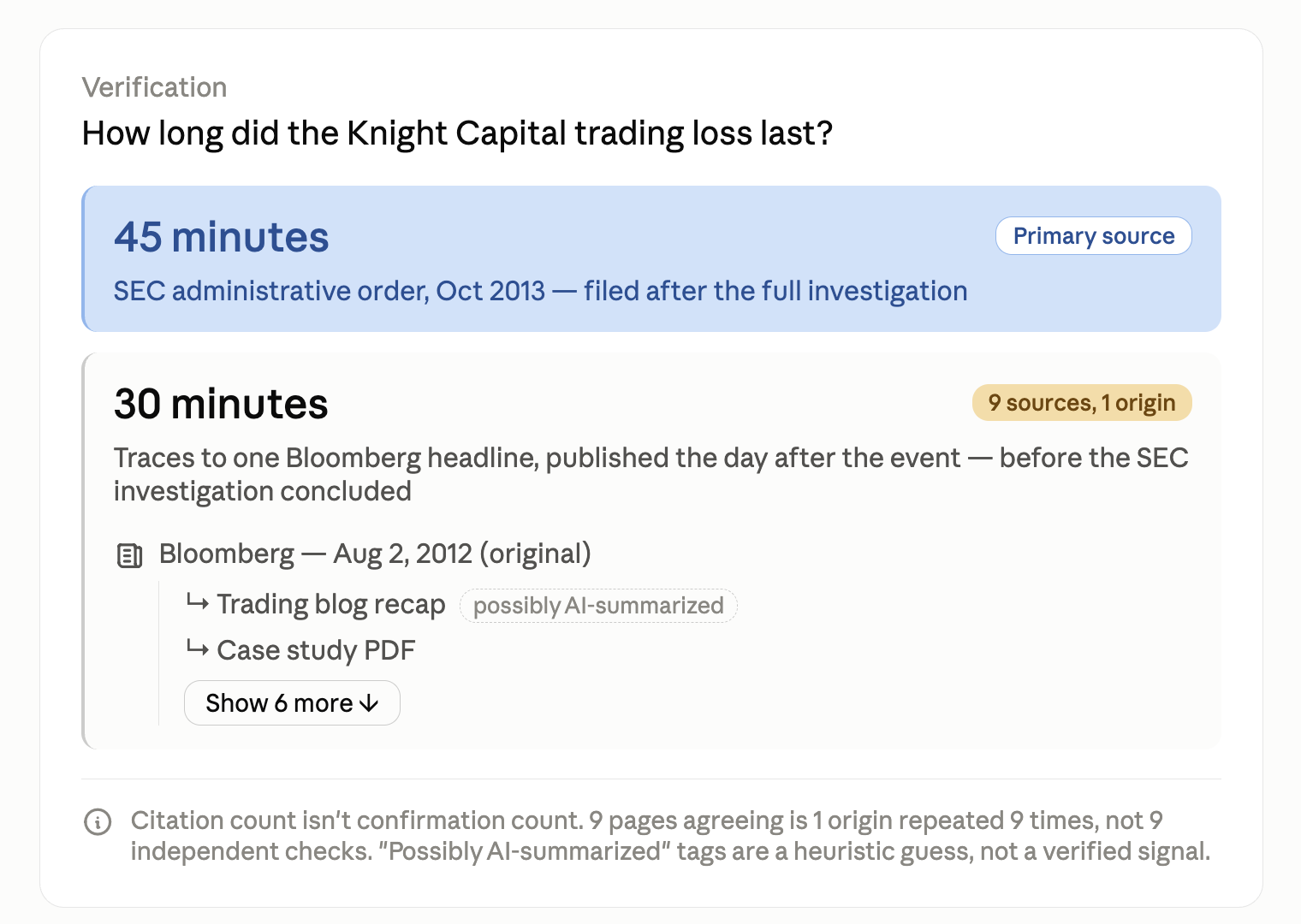
Nobody called this an AI agent in 2012 — the term didn't exist yet in its current sense — but the shape is identical: a system taking real-world actions in a loop, with no human approving each one, and nothing built to notice it should stop. On August 1, 2012, Knight Capital pushed new trading software to eight servers. One kept old, dormant test code that got reactivated by mistake. It started buying high and selling low across 154 stocks, automatically, with nothing built to catch the pattern and stop it. It ran for 45 minutes — 9:30 to 10:15 a.m. ET — before anyone shut it down, per the SEC's 2013 order: over $460 million lost, roughly triple the firm's prior year's earnings. Stock down 75% in two days. Knight was sold to a competitor within months to survive.
What to watch for: a hard limit on time or trade volume before an automated process halts and hands control back to a person. Knight didn't have one. Nor did anyone verify the new code had landed the same way on all eight servers before it went live.
For leadership: the questions a trust metric can't answer on its own
None of the three failures came from a model that wasn't smart enough. Bard usually answered correctly. Watson for Oncology worked in plenty of cases. Knight's system worked on seven of eight servers. What was missing each time: someone whose job was checking whether trust in the system still matched what it could actually do.
Assign calibration, not just accuracy, to someone. Check whether stated confidence still tracks real performance, by segment, on a recurring basis — not only at launch.
Feed internal failure evidence into what customers are told. IBM had that evidence, in its own slide decks. Nothing changed the external claim before the business was sold off at a steep loss.
Give every autonomous process a hard stop. Not a limit on intelligence — an acknowledgment that a system performing exactly as designed can still be wrong in a way nothing inside it will notice.
faqs
Sources for the trust-calibration research and case examples
CNN — Google Shares Lose $100 Billion After AI Chatbot Makes an Error During Demo (cnn.com)
SAGE Journals — Trust in Automation: Designing for Appropriate Reliance (journals.sagepub.com)
SSRN — Algorithm Appreciation: People Prefer Algorithmic to Human Judgment (papers.ssrn.com)
arXiv — Measuring Attribution in Natural Language Generation Models (arxiv.org)
Bloomberg — IBM Sells Some Watson Health Assets for More Than $1 Billion (bloomberg.com)