
The Three Patterns Behind Every Human-in-the-Loop AI Feature
Last updated: July 24, 2026
Every AI product that hands decisions to a human, rather than automating them completely, relies on one of three patterns: approval gates, confidence-based escalation, or review queues. The distinction matters because the EU AI Act's Article 14 requires documented human oversight for high-risk AI systems — standalone high-risk tools like hiring and credit-scoring software must comply by December 2027, and AI embedded in regulated products such as medical devices by August 2028 — and U.S. state legislatures introduced well over 1,000 AI-related bills in 2026 alone. "We'll add a human in the loop" is no longer a design afterthought; it's a compliance requirement with a specific shape.
Most teams build the human-oversight screen last, after the AI feature already works, and it shows. The screen gets bolted onto whatever the backend team found convenient to expose. Naming the pattern before building it produces a noticeably better result, because each of the three solves a different problem and looks different on screen.
Pattern 1: the approval gate
A person reviews and approves a specific action before the system executes it. Nothing happens without a yes.
This is the right pattern when a single wrong action is expensive, irreversible, or customer-facing — a large payment, a contract term, a public-facing message. Stripe's fraud review flow is a good example: a flagged transaction shows the action, the reason it was flagged, and the cost of being wrong, compressed into something a reviewer can decide on in seconds. The design problem isn't the yes/no button — it's fitting "why does this matter" into a glance.
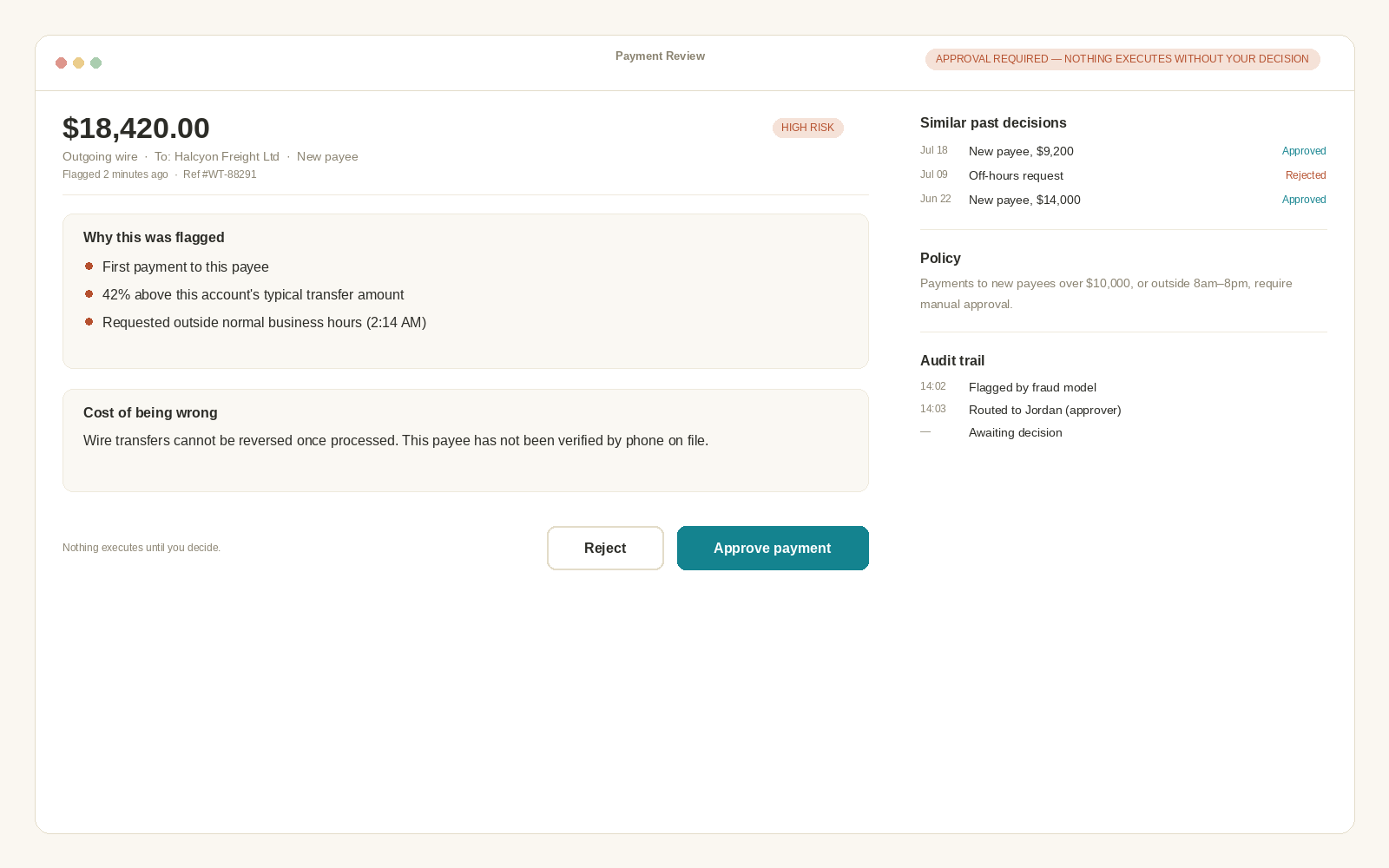
Approval gates fail when they fire on too many low-stakes actions. If a human has to approve everything, they stop reading and start rubber-stamping, which defeats the point of having a human there at all.
Pattern 2: confidence-based escalation
The system acts automatically on the cases it's confident about, and routes only the uncertain or high-risk ones to a person. Most of the volume never touches a human.
Radiology AI tools that flag scans for a radiologist to confirm use this pattern, and so does dispatch software that auto-routes straightforward jobs but surfaces the ones with a broken confirmation or an unusual delay. The interface problem here is different from an approval gate: it's not about one decision, it's about triage — what surfaces first, what context comes with it, and how fast someone can clear the queue without missing the item that actually matters.
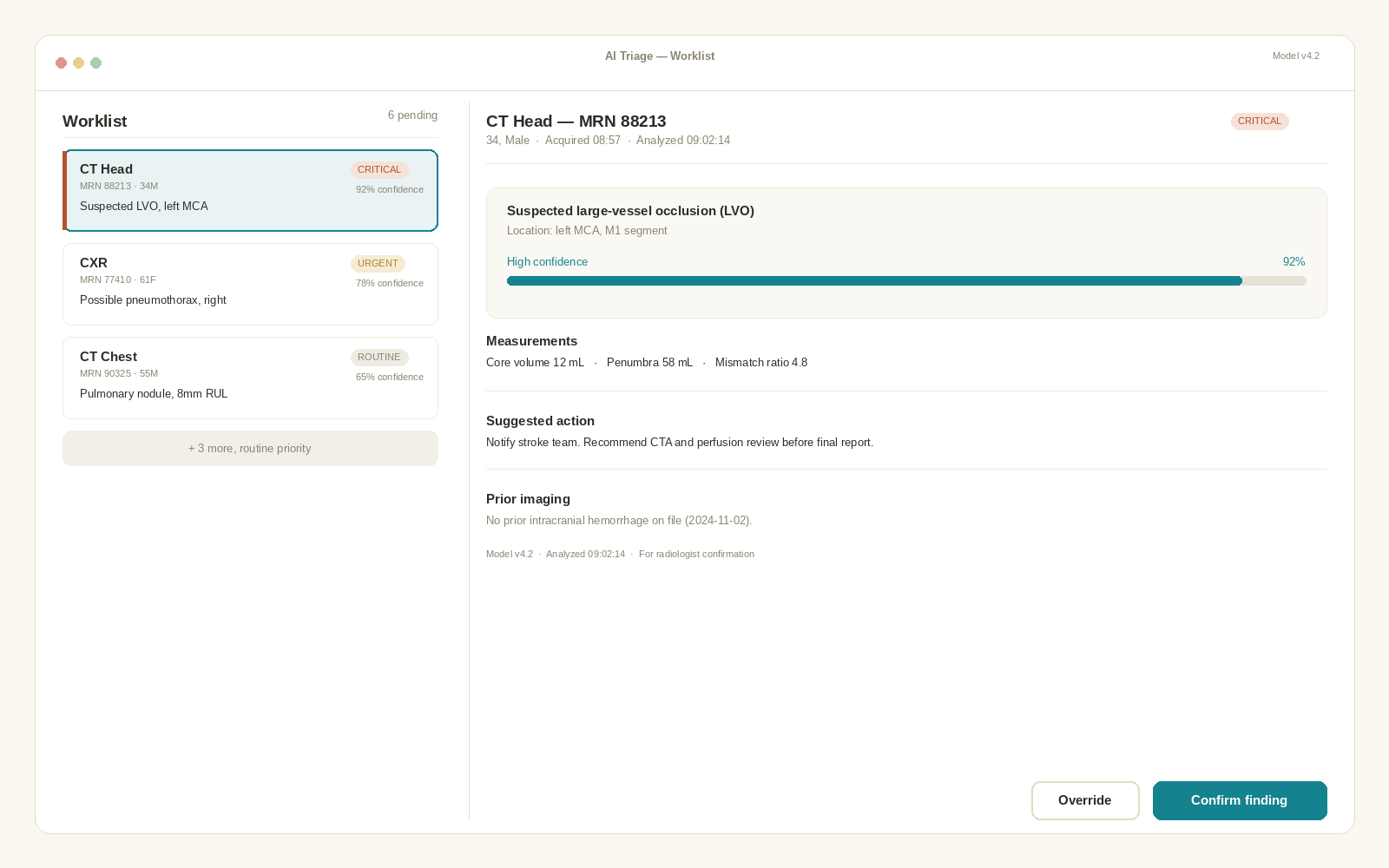
This pattern only works if the confidence threshold is calibrated honestly. A system that escalates everything isn't actually using AI; a system that escalates nothing isn't actually keeping a human in the loop.
Pattern 3: the review queue
A running list of items waiting for a human decision, generally lower-stakes individually than an approval gate, but requiring judgment the system can't yet make on its own — drafted customer replies, ambiguous content flags, edge cases a support tool couldn't resolve alone.
Support-AI tools that draft a reply for a human to approve or edit before sending are one of the best use case of this: the system produces a first pass, a person reviews it, and the loop closes fast because reviewing is quicker than writing from scratch. The design problem is queue management — what's the priority order, what's visible without opening the item, and how does someone clear ten of these in the time it used to take to handle two.

How to choose
Start from what happens if the AI is wrong, not from what the AI is technically capable of.
If a wrong action is expensive or irreversible: approval gate.
If most cases are safe to automate and only the exceptions need a person: confidence-based escalation.
If the output needs a human polish pass but starting from scratch is the real time cost: review queue.
Products that get this wrong tend to pick the pattern that was easiest to build, not the one that matches the actual risk profile of the decision. That mismatch is usually visible within the first week of real usage — either the human stops trusting the system, or they stop being able to keep up with it.
faqs
Sources for human oversight of AI system requirement
European Commission — AI Act Regulatory Framework & Timeline (digital-strategy.ec.europa.eu)
EU AI Act, Article 14 — Human Oversight (ai-act-service-desk.ec.europa.eu)