
How to Design the Dispatcher Exception Queue for AI Logistics
Last updated: August 5, 2026
Most AI dispatch software doesn't run everything through a human. It runs almost everything on its own and hands a dispatcher only the load or shipment it can't confidently resolve. Numeo, an AI dispatch platform for trucking, describes its own system this way: it aggregates loads, ranks them, drafts the outreach to brokers — and pushes the exceptions that need a person to the front of a queue, while a human approves every commitment the system makes on the carrier's behalf. That's confidence-based escalation, the second of the three patterns behind human-in-the-loop AI, applied to a running list instead of a single decision.
The design problem an exception queue solves isn't "should a human see this." It's "what does a dispatcher need to know in the half-second before they decide whether to open it."
What actually lands in the queue
A well-built exception queue isn't a dump of everything unusual. Numeo's queue surfaces specific categories: a load with a missing rate confirmation, a broker that isn't on the approved list, a driver delay that's about to break a delivery appointment, an offer that falls inside a band the system isn't confident enough to accept or reject on its own. Each of those is a distinct reason something needs a person, and each one implies different information on the row: a rate confirmation issue needs the rate and the broker's history; a delay needs the appointment window and how much buffer is left.
Treating "needs review" as one undifferentiated category is the most common mistake. A queue that can't tell a dispatcher why something is there, only that it is, forces them to open every item to find out — which defeats the entire purpose of triage.
Visibility is not the same thing as a queue
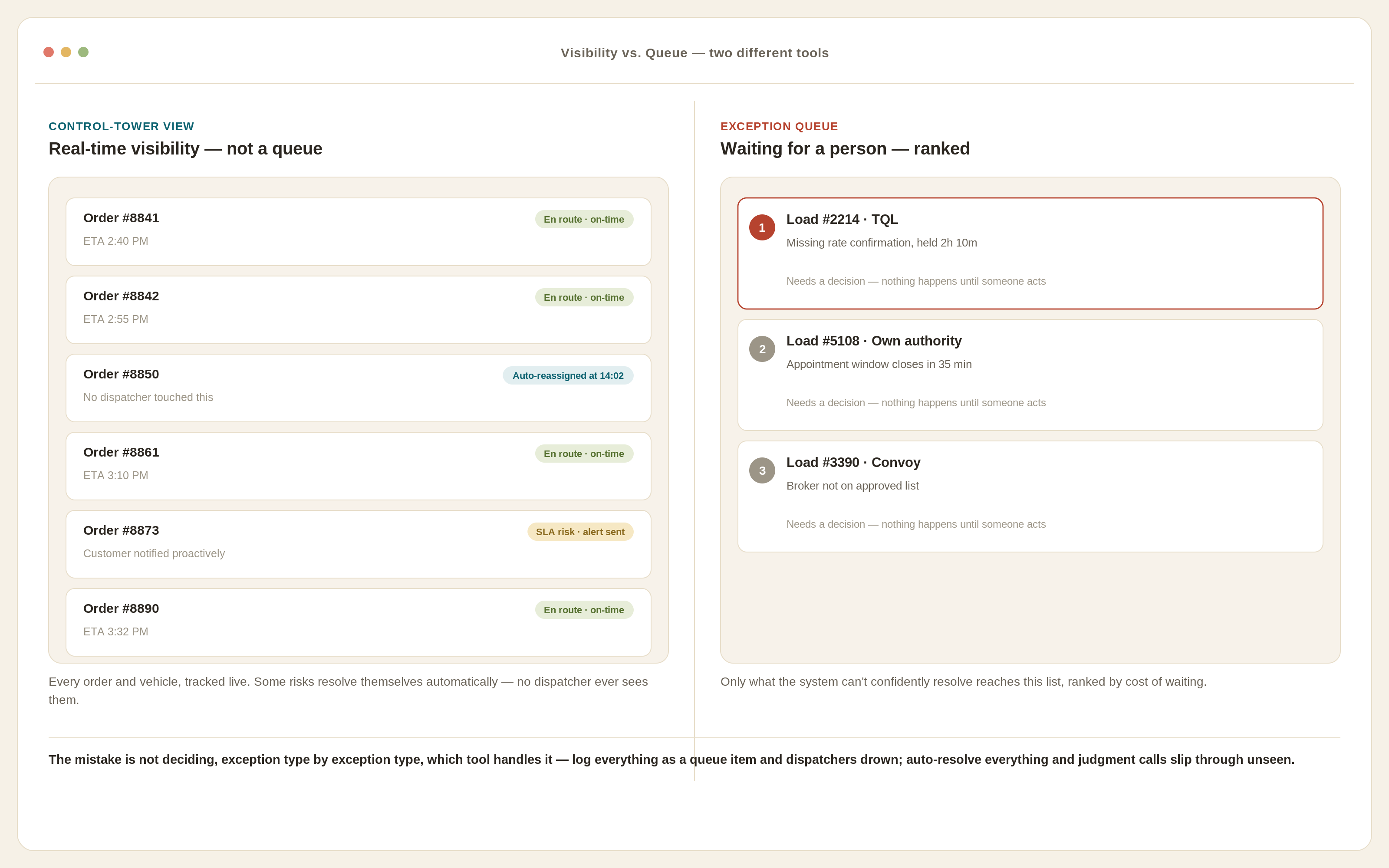
It's worth separating two tools that get conflated. Locus's Control Tower is a real-time visibility layer: a single dashboard tracking every order, vehicle, and driver, with predictive SLA-breach alerts surfaced as they emerge. Some of what it flags triggers an automated re-routing or reassignment workflow directly — no dispatcher touches it. Numeo's exception queue is a different shape: a specific, ranked list of items a person has to look at and decide on, one at a time.
Both are legitimate designs. The mistake is not deciding, for each category of exception, which one it is. If every SLA risk gets logged as a queue item, dispatchers drown in things the system could have resolved itself. If everything gets auto-resolved, the dispatcher loses visibility into judgment calls they should have caught. The design decision — surface it for a person to work, or resolve it automatically and only log it — has to be made exception type by exception type, not as a blanket policy.
Borrow the triage skill, not the industry
Prioritizing a queue so the most urgent item is on top, and giving just enough context to decide without opening four other tools, isn't a problem unique to logistics. Radiology worklists that flag scans for a radiologist to confirm, and content-moderation queues that route flagged posts to a reviewer, have both been refined for years around the same constraint: someone has to clear a list faster than they could evaluate each item from scratch, without missing the one that actually matters. The interface decisions worth studying from those fields are what goes in the one-line row summary, what's one tap away, and how an item gets marked resolved without losing the record of why.
What to watch for
A queue that shows everything isn't triage — it's a list with extra steps. If dispatchers start working it top-to-bottom out of habit instead of trusting the ranking, the prioritization has already failed, the same way an approval gate fails when it fires on too many low-stakes actions and the reviewer starts rubber-stamping.
The fix is the same discipline confidence-based escalation requires anywhere: track how often the item at the top of the queue was actually the most urgent one, and recalibrate when it isn't.
faqs
Sources
Locus — Control Tower Software (locus.sh)